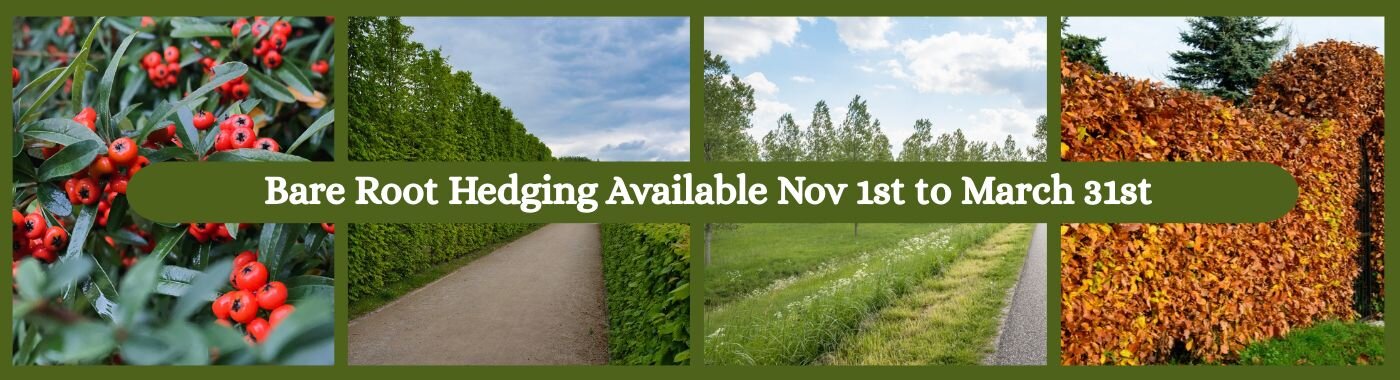




Fagus sylvatica known as Green Beech or Common Beech, this is one of the most majestic, culturally significant broadleaf trees in Ireland. Introduced centuries ago, it has become a defining feature of old country estates, sweeping parklands, and formal boundary lines. Celebrated for its smooth, sculptural trunks and incredible ability to adapt to severe shearing, it is widely considered the gold standard for structural hedging and architectural garden privacy screens. In late April and May, long winter buds split open to release delicate, neon-green leaves fringed with soft, silken white hairs. When kept regularly trimmed as a hedge or pleached screen, the branches hold on tightly to the crisp, coppery-brown foliage all winter long, releasing them only when fresh spring buds force them off. This provides flawless year round privacy and wind shelter despite being a deciduous plant.
Key Features
- Morphology & Form: Left to grow in the open, it becomes a massive specimen tree 25 to 35 metres with a vast, spreading, cathedral-like crown. In densely forested environments, it grows narrower and taller to reach the light.
- Foliage: Simple, oval leaves 4 to 10 cm long with a distinctly wavy margin. They emerge a brilliant, silky-haired lime green in spring, mature to a dark, lustrous green in summer, and transition to spectacular golden-yellow and copper-bronze tones in autumn.
- Winter Leaf Retention: When cultivated and tightly pruned as a formal hedge, it retains the dry, copper-brown autumn leaves which cling to the dense twigs all winter long, shedding only when fresh spring buds push them away. This grants excellent year-round privacy and wind filtration.
- Bark: Exceptionally distinct, smooth, silvery-grey bark that is often compared to elephant skin.
- Buds & Flowers: In winter, it is easily identified by its long, slender, sharply pointed reddish-brown winter buds that branch out at a sharp angle. It is monoecious, producing tassel-like male catkins and small paired female flowers on the same twig.
- Fruit (Beechnuts): Produces bristly, prickly, four-lobed wooden cups that split open in autumn to reveal small, triangular, oil-rich edible nuts known as beech mast.
Growing Conditions
- Sunlight: Performs best in full sun to partial shade.
- Soil Affinities: It is highly prized for its ability to thrive on fertile, alkaline calcareous soils, chalk, and limestone, though it adapts well to acidic loam, clay, and sandy substrates.
- Moisture Limits: Requires excellent, sharp drainage. It loves consistently moist soil but strictly cannot tolerate heavy, waterlogged, or boggy conditions.
- Sensitivities: Beech has a massive network of shallow roots. It is highly susceptible to root compaction and root disturbance caused by heavy foot traffic or lawnmowers. Its thin bark can also suffer from "bark scorching" if a mature tree's shading canopy is suddenly removed.
- Hardiness: Fully winter-hardy across temperate zones. However, late spring frosts can easily singe the fresh, newly emerging foliage and flowers.
Wildlife Value
- The Beech Mast Phenomenon: Beech trees reproduce in cycles known as "mast years," where they simultaneously drop massive bumper crops of nutritious nuts. This mast is a vital winter energy lifeline for red and grey squirrels, wood mice, voles, deer, and the rare hazel dormouse. Native birds like jays, nuthatches, and finches feed on them heavily.
- Caterpillar & Insect Life: The soft spring leaves are a major forage resource for the caterpillars of specialized woodland moths, including the barred hook-tip and clay triple-lines moth.
- Winter Hedgerow Shelter: When maintained as a hedge, the retained, dried winter leaves offer excellent thermal cover and camouflage for overwintering insects, small foraging mammals, and birds seeking refuge from winter predators.
- Cavity Nesting: As trees mature and develop age-related structural hollows, the soft wood easily provides essential nesting sites for cavity-nesting birds like owls and roosting native bats.
- Understory Adaptation: In midsummer, the dense beech canopy casts a sweeping shadow that blocks most sunlight, accompanied by a thick carpet of slow-decaying leaf litter. Specialized forest floor plants like native bluebells and wild garlic have adapted perfectly by completing their entire flowering lifecycle in early spring before the beech trees fully leaf out.
- ColourGreenish Yellow
- PlacementAny soil, not too wet.
- FloweringApril-May
- Pot SizeBare Root
- PollinatorYes
- Plant Spacing3 to 4 Plants Per Metre
- Mature Height25m-35m
- Mature Spread20m-30m
Enquiry
Do you have questions about this product? Feel free to send us an enquiry so we can help you. We store your data securely according to our privacy policy.
Delivery
When you order from Ahern Nurseries & Plant Centre, we'll ensure the shipping and delivery will be fast and hassle-free. All of our products can be delivered nationwide for €9.99. We will keep you updated about the shipping time via e-mail. Do you live close by? You can always stop by to pick up your items for free.
Give call us on 087 1671884 or email us if you have any questions regarding the delivery of your products.