


Sorbus aucuparia is our Native Mountain Ash, or Rowan Tree. It is one of the most beautiful, resilient, and culturally significant deciduous trees native to Ireland. Known as the "Tree of Protection" in Celtic folklore, it populates steep mountain slopes, upland forests, and windswept countryside hedgerows where other trees struggle to take root. The leaves are elegantly pinnate (feathery), split into pairs of 9 to 15 narrow, serrated leaflets on a central stem. Because the canopy is relatively light and open, it filters a soft dappled shade that allows smaller garden perennials or grass to grow comfortably right up to its trunk.
Key Features
- Feathery Foliage: Features graceful, alternate, odd-pinnate compound leaves containing 9 to 15 elongated leaflets arranged opposite each other along a central spine. Unlike true ash leaves, rowan leaflets are smaller and have sharply serrated or jagged edges. In autumn, the canopy shifts into a dramatic display of burnt orange, bronze, and vibrant red foliage.
- Flowers: Erupts in May and June with dense, flattened, frothy clusters (corymbs) of creamy-white, 5-petalled flowers. They carry a distinctive, heavy scent that quickly commands the attention of woodland insects.
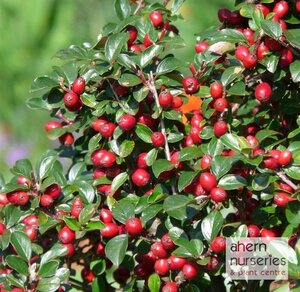
- The Berries (Rowanberries): Following successful spring pollination, the flowers ripen by late summer into hanging, spectacular umbrella-clusters of spherical, glossy orange-to-scarlet red berries measuring 8 to 10 mm across.
- Form & Bark: Grows with a neat, narrow, and upright-oval habit that rounds and opens gracefully with age, reaching an ultimate height of 8 to 15 metres. The bark is beautifully smooth, shiny, and silvery grey-brown, frequently hosting small white lichens and patches of moss.
- Winter Buds: Easily distinguished in winter by its distinctive, striking purplish-black buds that are coated in a fine, downy grey velvet.
Growing Conditions
- Sunlight: Performs best in full sun to light partial shade. It is relatively intolerant of deep or heavy canopy shade, needing clear access to light to synthesize its heavy loads of autumn berries.
- Soil Type & pH: Displays a powerful, natural preference for acidic-to-neutral, poor, and rocky ground. It settles successfully into sandy loams, gravels, and thin upland soils.
- Soil Restrictions: Strictly avoids and dislikes heavy clay or highly alkaline, dry calcareous soils.
- Moisture Exceptionalism: Loves moist, well-drained conditions. Because it transpirates rapidly, an established rowan can absorb substantial amounts of water, actively aiding in land drainage on wet, damp hill slopes. However, it does require a free-draining profile, as it struggles in stagnant, anaerobic bogs.
- Exposure Resilience: Fully winter-hardy and highly wind-resistant. It handles cold, high-altitude exposure, driving rain, and mountain gales with absolute ease, though it should avoid severe, direct maritime sea-salt spray.
- Management: Thanks to its moderate, non-invasive size, it is widely praised as the ideal small-to-medium garden tree.
Wildlife Value
- The Avian Winter Larder: The early-ripening scarlet berries are an invaluable, high-energy fuel resource for wildlife. They are aggressively scavenged by resident and migrating birds, most notably thrush species like blackbirds, song thrushes, fieldfares, and redwings, alongside large flocks of visiting waxwings. The mistle thrush holds a famous relationship with the rowan, aggressively defending a single tree through the winter as its personal feeding territory.
- Seed Dispersal Symbiosis: The birds process the soft berry pulp and scatter the intact seeds widely across distant hillsides in their droppings, acting as the tree's primary vehicle for natural propagation.
- Pollinator Support: The prominent spring flower clusters produce vast quantities of nectar and pollen. They act as a major refueling hub for honeybees, bumblebees, and native hoverflies early in the nesting season.
- Invertebrate & Mammal Forage: The delicate compound leaves serve as preferred forage for the caterpillars of several native moth species. In wild upland forests, the foliage and young shoots are also highly sought-after winter browsing food for native red deer.
- Crevice Habitats: As the smooth bark matures and develops small fissures, the resulting crevices provide a stable, safe habitat for an array of over-wintering insects and spiders.
- BiodiversityExcellent
- ColourCreamy White
- PlacementAny soil
- FloweringMay-June
- Pot SizeBare Root
- PollinatorYes
- Mature Height8m-12m
- Mature Spread4m-7m
Enquiry
Do you have questions about this product? Feel free to send us an enquiry so we can help you. We store your data securely according to our privacy policy.
Delivery
When you order from Ahern Nurseries & Plant Centre, we'll ensure the shipping and delivery will be fast and hassle-free. All of our products can be delivered nationwide for €9.99. We will keep you updated about the shipping time via e-mail. Do you live close by? You can always stop by to pick up your items for free.
Give call us on 087 1671884 or email us if you have any questions regarding the delivery of your products.